
Cattle Novelties Ltd
Advanced water-based epoxy moisture barrier
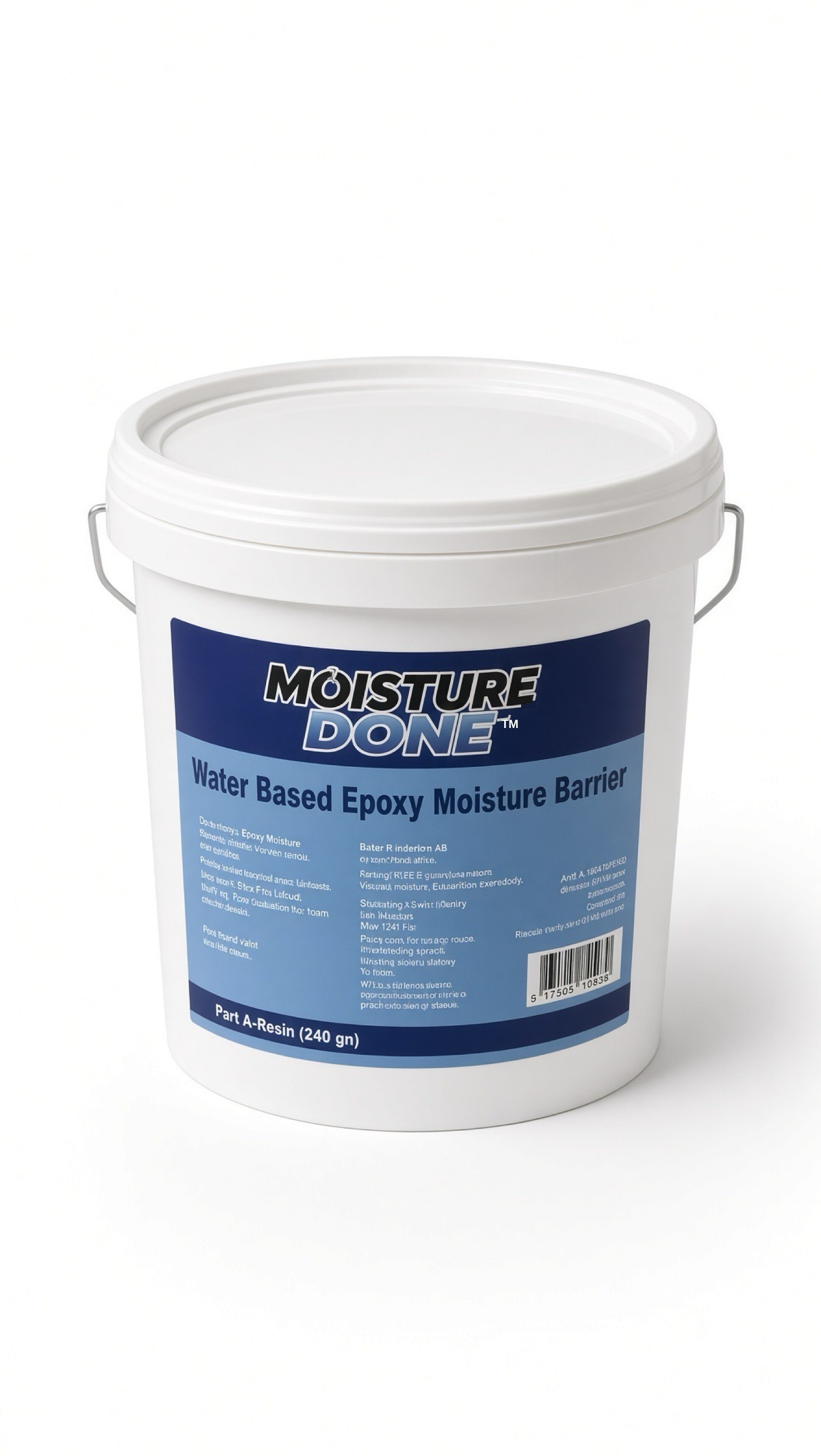
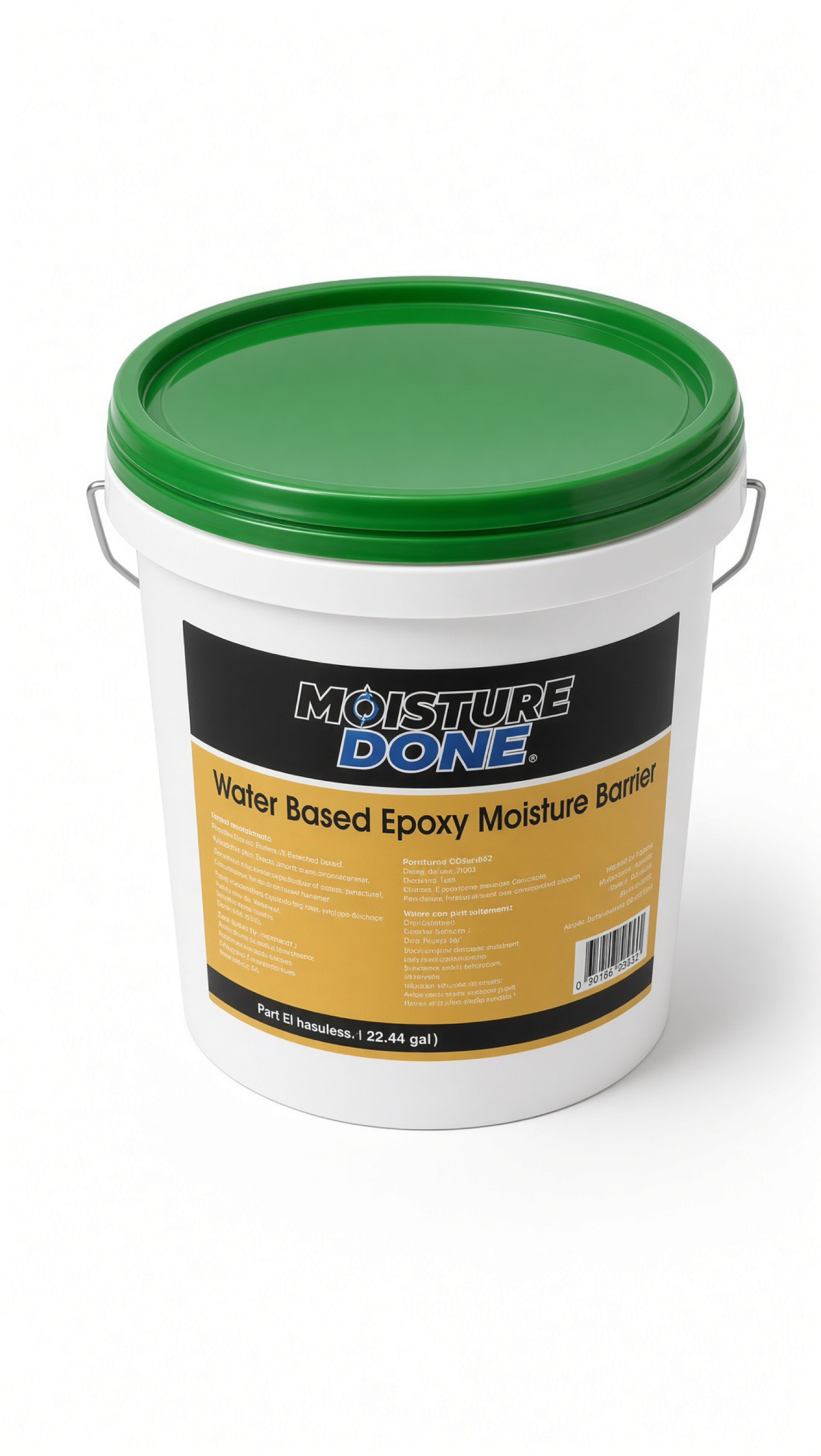
Moisture Done™ is a two-part, advanced water-based epoxy polyamide coating with Advanced Moisture Inhibiting Barrier Technology. It's not a paint, and it is not an ordinary waterproof coating. Mixed together, Part A and Part B harden into a dense film that soaks into concrete and masonry, holds back moisture and vapour, forms a protective barrier, and gives paint and adhesive something firm to stick to.
Advanced Moisture Inhibiting Barrier Technology
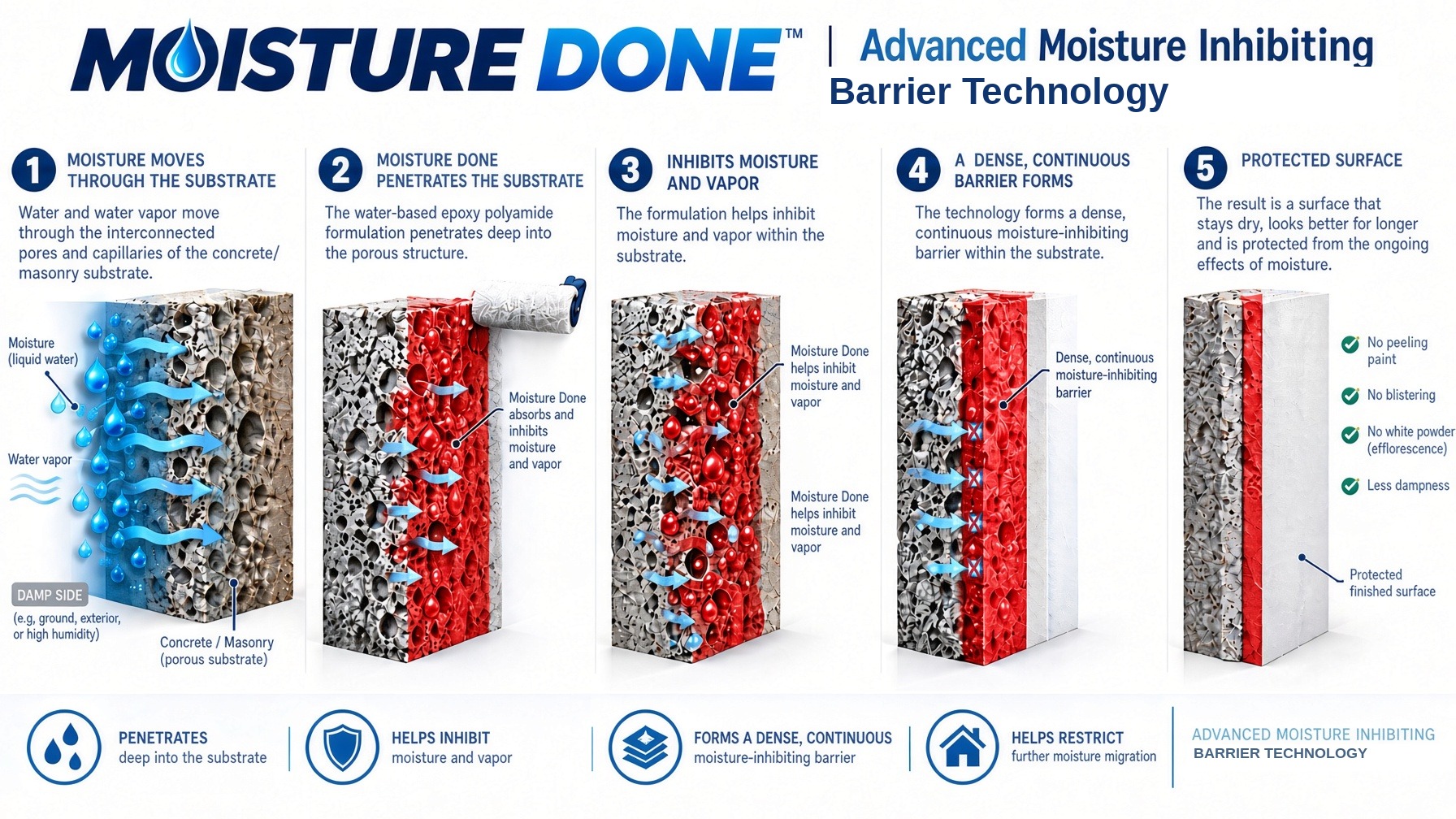
Our advanced moisture-inhibiting barrier technology is engineered to penetrate deep into the porous structure of the substrate, creating a dense, continuous barrier within the material. As the system cures, it also forms a durable protective barrier across the surface, creating a dual-layer defense that helps restrict moisture migration from within and protect the surface.
Moisture is controlled from within and protected at the surface—not simply covered over. It's not a paint.
Moisture Done™ forms a high-performance moisture barrier that helps restrict water vapour and moisture migration through concrete, masonry, and other compatible surfaces. By addressing moisture beneath the paint layer, it helps protect against peeling paint, blistering, damp patches, and efflorescence.
What it does
It resists water, rising damp, and efflorescence, and it stands up to hydrostatic pressure in construction. Adhesion is strong on most substrates, including damp surfaces and freshly laid green concrete. It is suitable for potable-water situations.
Don’t paint over the problem. DONE it.
Painting over the wall will not solve the problem. The moisture is still in the concrete, so the new paint peels too. It's not a paint, and an ordinary waterproof coating that only sits on the surface will not solve it either.
Once mixed, Moisture Done™ goes into the pores and cures there. It penetrates the concrete and cures into a barrier between the concrete and the paint. That is Moisture Done™ in the wall. Paint goes on the outside of that barrier. Red in the diagram is the barrier. The coating itself dries grey or black.
Advantages
- Non-flammable, with a negligible odour.
- Can be applied to damp surfaces.
- Can be applied to freshly laid, hardened green concrete.
- On a substrate, the cured membrane withstands 250 kPa of hydrostatic pressure — a 25 metre head of water.
- Can be overcoated with almost any decorative or industrial finishing paint.
- As a dual barrier coat, it helps prevent rising damp and efflorescence.
- Adheres to brick, masonry, concrete block, concrete, stone, timber, cement board, gypsum board, and other compatible porous building substrates.
- Cleans up with water.
- Safe for potable water.
How inhibition works
The pores are the path. Liquid water and water vapor move through the concrete to the paint, and the paint peels. Moisture Done™ enters those pores and cures into the barrier between the concrete and the paint. It's not a paint. Water and vapor stop there. The paint stays on the dry face.
Where it is used
- A low water-vapour transmission coating, and a barrier over freshly laid or damp concrete.
- A hydrostatic-pressure resistant membrane against seepage through walls and floors.
- A negative-side barrier below grade: basements, tunnels, liftwells, retaining walls, underpasses, and carparks.
- A moisture barrier over green concrete before levelling compounds, carpet, or tile adhesive.
- A tanking membrane, including potable-water containment, swimming pools, and concrete cistern walls.
- A barrier seal over damp, green, or efflorescing concrete before conventional building paints.
- Indoor walls and wet rooms, including restrooms.
How to apply it
Brush or roller. The numbers below follow the product specification.
01
Clean the base
Grind off loose sand, soil, paint, mud, and moss. Fill cracks or holes you can see with cement mortar or a repair material before you coat.
02
Wet thirsty surfaces
Masonry and cement that soak up water should be dampened first. There should be no standing water.
03
Mix equal parts
Pour Part B into Part A at 1:1 by volume. The drums are already matched. Mix until it is uniform. Do not dilute it. Close the containers as soon as you finish so the water does not skin over.
04
Roll or brush
Apply in a vertical, crosswise pattern. Two coats make the specified barrier. Wait at least 4 hours between coats. Keep each wet film at 0.3 mm.
05
Let it cure
Full cure is 24–48 hrs. Paint, tile, or other work starts after that cure. In direct sun, add paint, tile, or another protective layer.
Part A resin and Part B curing agent
Specification
- Product
- Two-component advanced water-based epoxy polyamide moisture barrier
- Pack
- Part A resin 10 L (2.64 gal) and Part B curing agent 10 L (2.64 gal)
- Colour
- Grey or black
- Finish
- Semi-gloss, going matt as it ages
- Volume solids
- 44%
- Mix ratio
- 1:1 Part A to Part B by volume. Do not add thinner.
- Coverage
- 1.5 m² per litre for the full system — two coats at 3.0 m² per litre each
- Wet film
- 0.3 mm (300 micrometers) per coat. Do not exceed 0.5 mm in one layer.
- Recoat
- 4 hours at 25°C and 50% relative humidity
- Pot life
- 2 hours at 25°C. 1 hour at 35°C. Use it as soon as it is mixed.
- Full cure
- 24–48 hrs
- VOC
- 26 g/L
- Shelf life
- 24 months unopened
- Storage
- Cool and dry, 5°C to 35°C. It may freeze. Thawing does not spoil it.
- Made for
- Manufactured for Cattle Novelties Ltd.
How much for this area
Two coats at the specification rate of 1.5 m² per litre. One set is 20 litres.
Approx. Practical coverage range 300 - 400 sq.ft. depending on surface porosity, texture, application method and substrate condition.
Get a quote
Tell Cattle the area you would like to do.
Enter an area above zero.
WhatsApp usEmail CattlePrecautions
- Keep the job between 5°C and 35°C. Do not coat outdoors in rain, or in high heat where water flashes off and the surface cracks.
- A wet film thicker than 0.5 mm can crack. Wait until the coat is dry before the next one.
- After cure the film shrinks. It is not a filler for large gaps.
- Do not leave Part A or Part B open. A skin can form. Stirring it back in does not ruin a short exposure, but a long one thickens the product.
- Do not dump unused single-component material. It can be mixed with the other part and used after it cures. Otherwise follow local waste rules.
- Do not add anything else to the product.
DIY
Technical support
Safety data sheets are available from Cattle Novelties Ltd on request. The advice in these instructions is for general conditions. Substrate, weather, workmanship, and materials all change the result. The person applying it has to judge the site. The manufacturer is not responsible for bond failure caused by storage or work outside these instructions, a poor substrate, or abnormal conditions.
Don’t paint over the problem. DONE it.
Where to find it